- 01The short version: they floated a base station in the air and built a temporary coverage area
- 02Why does a disaster knock out your signal in the first place?
- 03When the streetlights go out, hold a flashlight up high
- 04What they flew, and how they delivered the signal (as reported)
- 05Keeping the antenna pointed while flying
- 06How fast is it? Is it actually usable?
- 07What we still don’t know
- 08How it differs from satellites and remote mountain signals
- 09Summary
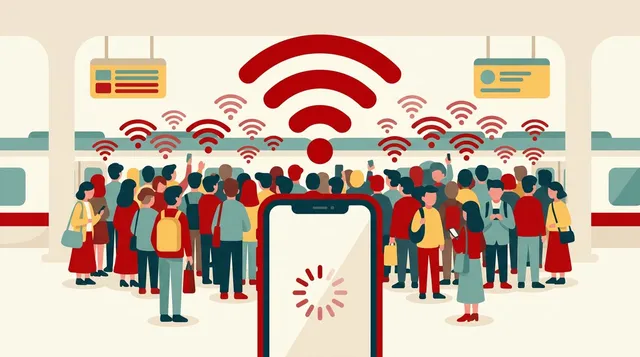
In a disaster, your phone drops to “No Service.”
Right when you need it most, it doesn’t connect.
“Wait, base stations can break?” Yeah. They can.
Today’s story is about an experiment to fill that gap from the sky.
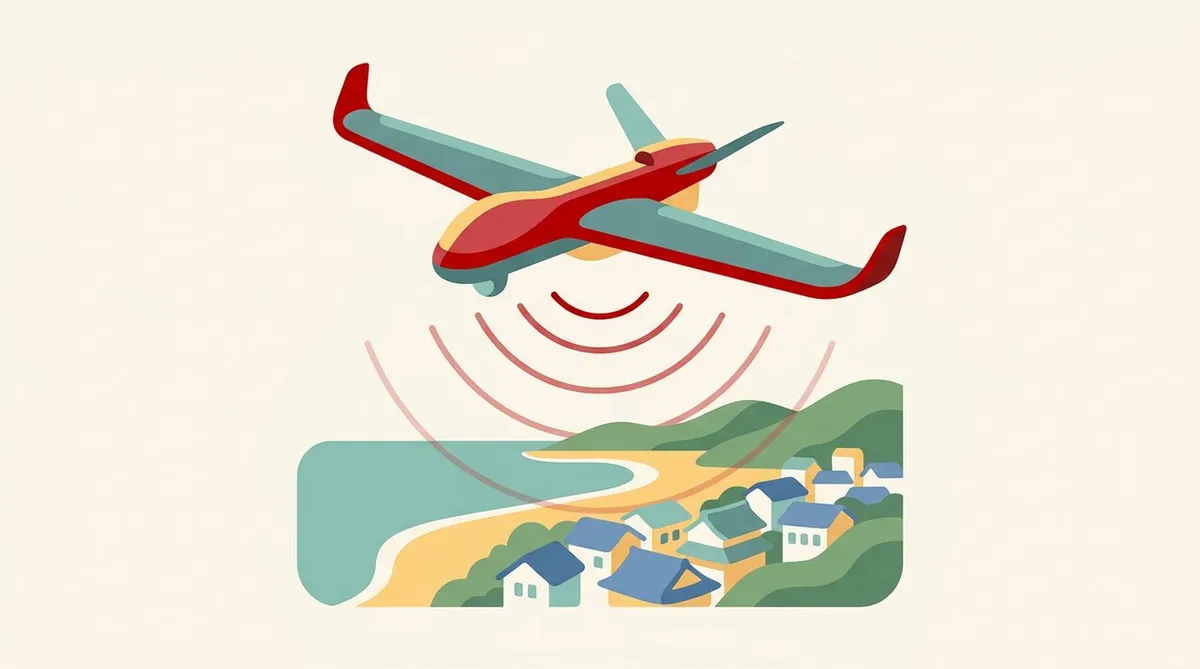
The short version: they floated a base station in the air and built a temporary coverage area
On October 2, 2026, Keitai Watch reported that SoftBank had successfully demonstrated service to mobile devices on the ground from an unmanned aircraft flying 3,000 m up.
The coverage area created on the ground is said to be more than 5 km in diameter.
The easy way to picture it: a base station that normally stands on the ground, lifted up into the sky.
Why does a disaster knock out your signal in the first place?
A base station is the equipment that puts out the radio signal.
In a disaster, it can stop working.
- A power outage cuts electricity to the equipment
- The line connected to the base station gets cut
- The equipment itself gets damaged
If it can’t put out a signal, that area has no service.
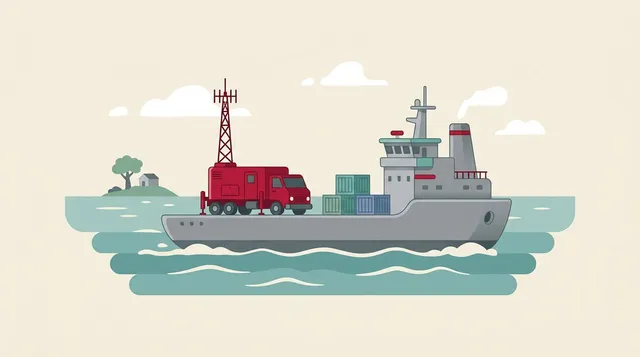
So far, the usual approach has been to build a temporary area with things like mobile base station vehicles, which carry a base station on a truck. But if the roads are impassable, the vehicle can’t get close.
From the sky, you’re less affected by road conditions. That’s my own guess, but I think it’s one advantage of delivering signal from above.
When the streetlights go out, hold a flashlight up high
Here’s an analogy.
Ground base stations are streetlights.
On a night when the streetlights are out, shine a flashlight from a high place and a wide area lights up.
In this experiment, an unmanned aircraft played the role of that “high place.” Transmit from high up, and there’s less in the way, so the signal reaches a wider area more easily.
What they flew, and how they delivered the signal (as reported)
Here’s what the report says.
- Location: the coast of Kuroshio Town, Kochi Prefecture
- Altitude: 3,000 m
- Aircraft: the “MQ-9B SeaGuardian” unmanned aircraft from US-based GA-ASI, owned by the Japan Coast Guard
- Payload: the “DRU pod,” a communications pod designed and manufactured in Japan
- Coverage created on the ground: more than 5 km in diameter
- Said to be the first demonstration in Japan of communications from the air using a domestically designed and manufactured pod for a large unmanned aircraft
The signal path is a little complicated.
- A “gateway” is built from a ground LTE base station and a relay device that converts frequencies
- The gateway converts 2.1GHz band signals to 3.3GHz and sends them up to the aircraft
- A relay device inside the aircraft converts them back to 2.1GHz and delivers them to phones on the ground
The aircraft up there acts as a go-between for the ground base station and the phones.
Keeping the antenna pointed while flying
The unmanned aircraft flies in circles. It tilts and it shakes.
Even so, it has to keep sending signal toward the ground coverage area and the gateway.
The pod’s antenna uses “gimbal technology” that compensates for changes in the aircraft’s attitude and for shaking. It keeps its direction steady, like the image stabilization in a camera.
With this, the antenna direction is said to be controlled properly even while the aircraft is circling.
How fast is it? Is it actually usable?
The speeds confirmed outdoors were up to 20 Mbps down and up to 5 Mbps up (5 MHz bandwidth).
That’s not fast enough for watching high-quality video.
But the goal isn’t everyday use. It’s temporary communications in a disaster. The report says the aim is to check whether quality is good enough for things like confirming people’s safety right after a disaster, and for local governments and rescue agencies to share damage conditions by images and video.
What we still don’t know
Let’s be upfront here. The report does not say the following.
- The date of the experiment and the flight time
- The number and types of devices that connected
- A specific timeline for practical or commercial use
- Costs
SoftBank is said to aim to improve the technology using the data gathered and put it into society as emergency area coverage for disasters. The experiment was part of the National Institute of Information and Communications Technology (NICT) “Beyond 5G (6G)” fund program.
How it differs from satellites and remote mountain signals
There are other ways to deliver signal from the sky.
- Low Earth orbit satellites are covered in our beginner’s guide to satellite communications
- Why you lose signal deep in the mountains is covered in our article on mountain signals
This unmanned aircraft flies much lower than a satellite. Being closer to the ground, I’d guess it suits targeting a specific area to build a temporary zone. That’s just my take. Which one fits better depends on the situation.
There are also networks, like Rakuten Mobile’s, built around the idea of covering for a stopped base station from the surrounding area. We introduce that in our article on physical AI.
Summary
- SoftBank successfully demonstrated delivering service to devices on the ground from an unmanned aircraft 3,000 m up (said to be the first in Japan with a domestically designed and manufactured pod)
- It created an area more than 5 km in diameter on the ground and confirmed up to 20 Mbps down and up to 5 Mbps up
- The purpose is temporary communications in disasters. Not everyday speeds, but a check on whether quality is enough for confirming safety and sharing damage conditions
- The date, number of devices, commercialization timing and cost are not stated in the report
Connectivity is something we take for granted in normal times. How far has preparation for when it stops actually come? News like this gives us a way to look at that.
Source: Keitai Watch
This article contains affiliate advertising. If you apply for a product or service through links on this site, we may receive compensation from partner companies. Additionally, the operator is an employee of Rakuten Group and may receive compensation through an employee referral program. Article content and evaluations are based on the operator's actual experience and research, regardless of advertising. For details, see the Disclaimer & Affiliate Disclosure. Disclaimer & Affiliate Disclosure
This article contains machine translation. For official terms, please refer to the multilingual pages on the official Rakuten Mobile website.
If you have concerns about Rakuten Mobile's coverage area or signal conditions, you can inquire through the official signal improvement survey request form .